

 Explainer
Freight Invoice Delay: Why Invoices Go Out Late and How to Bill on Delivery Day
Freight invoice delay occurs because paperwork lags behind physical delivery. Days are lost waiting for proof of delivery, reconciling conflicting document quantities, digging detention notes out of driver chat logs, and manually bundling custom invoice packs for each customer. Billing systems cannot generate an invoice until these underlying operational records are gathered, verified, and reconciled.
This post covers what actually causes freight invoice delay and how to tell whether it’s costing you. It also gives a method you can run yourself to bill closer to the day of delivery.
Key takeaways
- Freight invoice delay originates in field operations and document collection, not in finance or accounts receivable software.
- Customer payment terms begin on the invoice date, meaning every billing delay directly inflates working capital needs and DSO.
- Paperwork discrepancies and mismatched counts generate customer payment disputes that hold up settlement for weeks.
- Reconciling shipment documents upon delivery and routing only exceptions to human clerks allows invoices to release on delivery day.
What causes freight invoice delay?
Most of the delay sits in five places, and almost none of them is in the billing system. In our experience, two or three of them account for most of the lost days in any given operation.
The proof of delivery arrives late, or in the wrong place
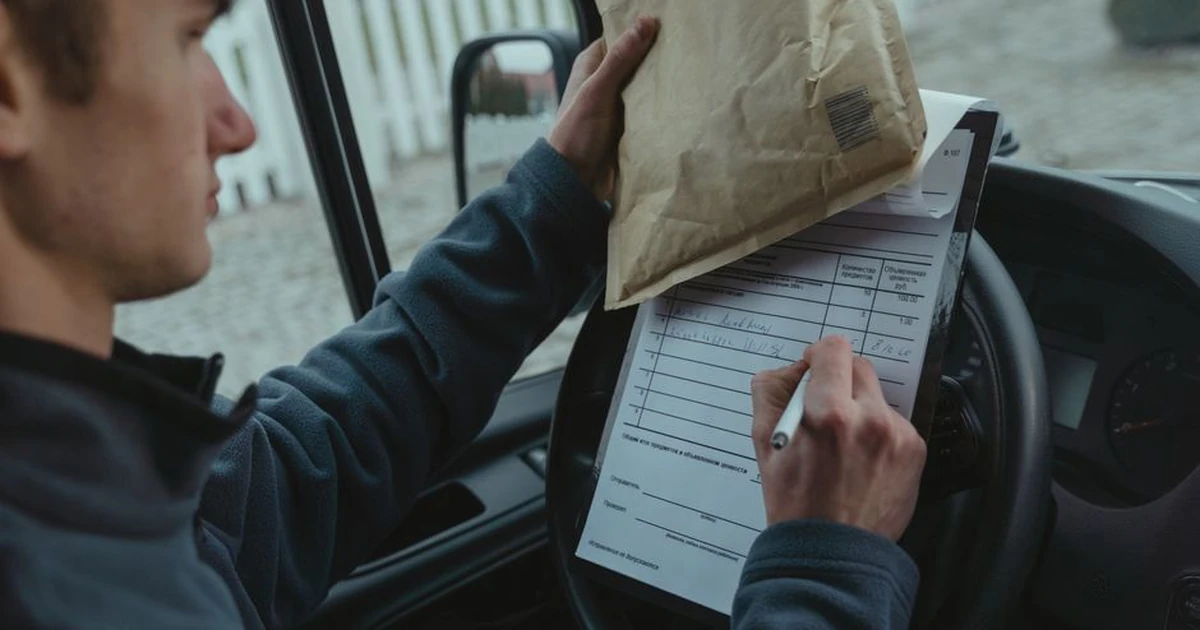
The driver gets a signature, takes a photo and sends it on WhatsApp to the dispatcher who booked the load. Or the paper copy stays in the cab until the truck is back at the depot. Either way, the invoice can’t go out until someone finds the POD, renames it and attaches it to the right shipment.
The documents don’t agree
The bill of lading says 22 pallets, but the order said 24. The packing list uses the customer’s article numbers, while the invoice uses yours. Someone has to reconcile them before release, and that someone is usually busy with today’s loads, not last week’s.
Extra charges surface after the fact
Waiting time, detention, a redelivery, an extra stop: these are agreed or reported in calls and messages, not in the TMS. Billing either waits for someone to confirm them, or invoices without them and sends a second bill later. Customers dispute second bills more readily than first ones.
Invoices are assembled in batches
Many teams build invoice packs once or twice a week. A load delivered on Tuesday waits for Friday’s run, however clean its paperwork is.
Every customer wants a different pack
One shipper needs the CMR and a signed POD uploaded to its portal. Another wants a PDF bundle by email, with its PO number in the subject line. These rules live in a spreadsheet, or in one billing clerk’s memory.
How much does a late freight invoice actually cost?
A late invoice costs the same as a late payment, except that the delay is internally generated. Commercial payment cycles in freight are already lengthy. In Atradius’s 2025 payment practices survey of Dutch businesses, which included 70 transport companies, late payments affected 35% of B2B invoices, and average payment terms stood at 45 days.
Payment terms usually run from the invoice date, so every day an invoice waits to be issued comes on top of them. With 45-day terms, four days of document assembly means the earliest you can be paid is day 49 after delivery. Multiply that across every load in a month and the working capital tied up becomes visible.
Downstream invoice disputes add to it. Atradius respondents in the Netherlands named disputes or issues with invoices as the second most common reason business customers pay late, cited by 31%. Mismatched documents feed those disputes directly, because the customer holds payment until the paperwork agrees.
Transport companies feel this more than most. Among Dutch transport operators evaluated by Atradius, 37% had used invoice financing in the previous year. Late payments topped their list of challenges in extending credit to customers, named by 44%. Financing an invoice you issued four days late means paying twice for the same delay.
Is invoice delay hurting your operation?
Check your operation against these signs. If three or more apply, measure days-to-invoice before you change anything else.
- You track DSO but not days-to-invoice. You know how long customers take to pay, but not how long you take to bill.
- PODs arrive through more than one channel. They come in by email, WhatsApp, the driver app, and on paper left in the cab.
- Extra charges are found by reading chats. Detention and waiting time get billed only when someone remembers the conversation.
- Invoices go out in a weekly run. A clean pack still waits for the batch.
- Most disputes are about paperwork, not price. The usual causes are a missing POD, a wrong reference, or a weight that doesn’t match.
- One person knows each customer’s document requirements. When that person is on holiday, invoices wait.
- Second invoices are routine. Extra charges regularly follow the main invoice by days.
How do you bill freight on the day of delivery?
You don’t need new software to start. These steps work in any operation, and the first two cost nothing but attention.
- Measure days-to-invoice separately from DSO. For every load over the next two weeks, record the delivery date, the invoice date and the main reason for any gap. The reasons will cluster. Fix the top two first.
- Define the billable pack for each customer. Write down exactly which documents, references and formats each customer needs before it will accept an invoice. Keep that list where billing and dispatch can both see it.
- Give proof of delivery one destination. Choose a single inbox or channel where every POD lands, and make it the driver’s default. A POD that has to be dug out of a dispatcher’s chat history is a delay built into the process.
- Record extra charges where they happen. When a driver reports waiting time or a dispatcher agrees a redelivery, log it against the shipment the same day. This is also how you stop under-billing; our post on revenue leakage in logistics covers what slips through otherwise.
- Match documents before release, not after the dispute. Check the order, the bill of lading and the POD against each other when the pack is assembled. A mismatch found on delivery day takes a phone call to fix. One found by the customer takes weeks.
- Release invoices daily. Once a load’s pack is complete, send it. Batch runs only make sense when the assembly work is manual.
- Send only the exceptions to a person. If the pack is complete and the documents agree, nobody needs to touch it. People’s time should go to the load with a missing signature or a weight that doesn’t add up.
Steps 3 to 7 are where the manual work piles up. That is the part worth automating.
Where does Intelligent Document Processing fit in?
Intelligent Document Processing takes over steps 3 to 7 for the documents nobody wants to handle by hand. It reads whatever arrives: email attachments, WhatsApp photos, portal downloads, and scans with stamps and handwriting, in more than 100 languages. It turns them into structured shipment data, then checks the packing list, invoice and bill of lading against each other before anything is released.
What matters most is how it handles doubt. Fields extracted with high confidence pass straight through. Doubtful ones, such as a smudged signature or a weight that doesn’t match the order, go to a person with the document open and the mismatch highlighted. Nothing is passed on a guess. Once integration is agreed, results are written straight into your TMS, WMS or ERP.
What it’s worth depends on where your days go. The mechanism is simple: the invoice goes out on delivery day, instead of after the 3–5 days that manual document assembly typically takes. We model up to a ~10% reduction in DSO and document packages processed up to 3× faster. Your actual numbers get measured in a pilot, on your own documents.
Late invoices are an operations problem first, so that’s where to fix them. To see how this works on your paperwork, there’s a paid pilot with a first result in 7 days and nothing written to your live systems. See how it works.
For where document automation sits among other uses of AI in operations, see our guide to AI in logistics. If you’re weighing a pilot, read why AI pilots fail in logistics first.
FAQ
What causes freight invoice delay?
Most freight invoice delay happens before an invoice exists. The usual causes are proof of delivery that arrives late or through scattered channels, documents that don’t match, extra charges agreed in calls or messages but never logged, invoices built in weekly batches, and customer-specific document requirements that only one person knows.
What is the difference between days-to-invoice and DSO?
Days-to-invoice measures the gap between delivery and the moment an invoice is issued, which is an internal operations metric. DSO (days sales outstanding) measures how long customers take to pay once invoiced. Track both, because a long days-to-invoice adds to your cash cycle without showing up in DSO.
How do late freight invoices affect cash flow?
Payment terms usually run from the invoice date, so every day spent assembling an invoice delays payment by a day. With 45-day terms, an invoice issued four days after delivery can’t be paid before day 49. Atradius’s 2025 survey of Dutch businesses found average B2B payment terms of 45 days.
Why do customers dispute freight invoices?
Most freight invoice disputes concern paperwork rather than price: a missing proof of delivery, a wrong reference, or a weight that doesn’t match the order. Extra charges billed later on a second invoice are also commonly challenged. Atradius found invoice disputes were the second most common reason B2B customers pay late.
How can you invoice freight on the day of delivery?
Measure days-to-invoice for every load and fix the most common causes first. Define the documents each customer requires, send every proof of delivery to one destination, and record extra charges the same day. Match documents before release, send invoices daily rather than in batches.
Sources
- Atradius’s 2025 payment practices survey of Dutch businesses — https://atradiuscollections.com/dam/jcr:9c5c0d77-736b-4738-8b3d-24965f274b61/payment-practices-barometer-western-europe-2025-the-netherlands-en-AC-NL.pdf
- Revenue Leakage In Logistics — https://blog.platform24.ai/blog/revenue-leakage-in-logistics-the-losses-your-billing-audit-wont-find/
- See how it works — https://platform24.ai/solutions/document-processing
- AI In Logistics — https://blog.platform24.ai/blog/ai-in-logistics-what-it-does-and-where-it-pays-off/
- Why AI pilots Fail In Logistics — https://blog.platform24.ai/blog/why-ai-pilots-fail-in-logistics-and-how-to-run-one-that-doesnt/