

 Explainer
What Is a TMS and What Does It Actually Do?
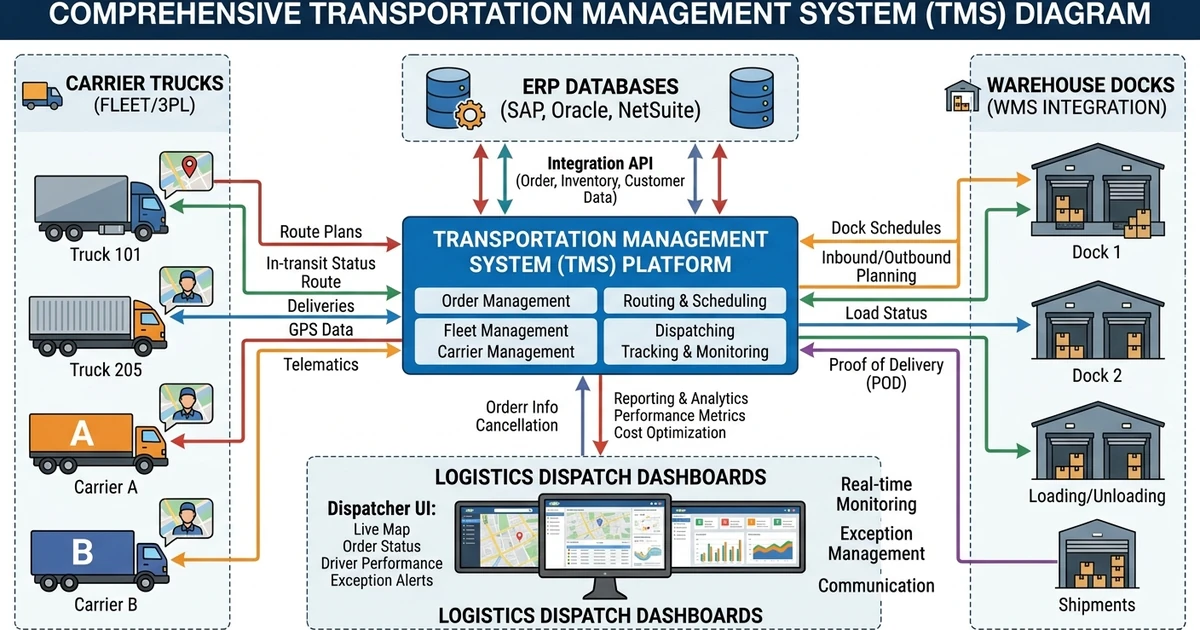
A Transportation Management System (TMS) is enterprise software that manages freight planning, carrier selection, shipment execution, and freight settlement. It acts as the core transactional platform for moving freight across supply networks, evaluating route configurations, monitoring milestone progress, and standardizing auditing workflows for shippers, freight brokers, and logistics service providers.
Key takeaways
- A TMS controls the entire freight cycle from initial carrier booking to final invoice reconciliation.
- Nearly a third of enterprise logistics organizations rely on optimized TMS systems for day-to-day transportation planning.
- Standard transport platforms focus on macro workflows, leaving unstructured communication and manual document intake to specialized operational layers.
What is a Transportation Management System (TMS)?
A Transportation Management System (TMS) functions as the central operating platform for logistics networks. When integrated with Enterprise Resource Planning (ERP) and Warehouse Management System (WMS) architectures, the system records freight transactions, procures contract rates, and assigns carriers according to cost rules. As freight networks increase in complexity, vendors rethink software origins. “Our Intelligent TMS is fundamentally different. It wasn’t bolted onto a visibility platform; it was born from it,” said Jett McCandless, Founder and CEO at project44 in an interview on Talking Logistics.
What does a TMS actually do across daily operations?
At its operational core, the platform schedules movements, dispatches loads to freight carriers, gathers milestone tracking telemetry, and executes freight payment auditing. The application centralizes transport contracts, generates digital load tenders, monitors transit timelines, and settles invoices. Output is a unified JSON object delivered over a REST API, ready for a TMS, WMS, YMS, ERP or customs system. By formalizing carrier compliance rules and billing constraints, shippers mitigate freight overbilling and avoid operational bottlenecks across complex regional distribution lanes.
How widely adopted are advanced transportation management systems?
Adoption levels span diverse system maturities throughout global transport operations. Survey figures from Talking Logistics demonstrate that 32% of logistics operators utilize an advanced TMS possessing enhanced software capabilities, while 28% operate a basic TMS dedicated strictly to standard operational planning and dispatch execution. Shippers scale these computational environments depending on freight network density, regional lane distribution, order consolidation requirements, and the volume of contracted third-party carrier relationships.
What role does optimization play in modern transport planning?
Transportation optimization engines analyze order weights, pickup deadlines, fuel surcharges, and equipment profiles to assemble optimal multistop loads. According to an industry study published by Talking Logistics, 29% of polled supply chain executives cite an enterprise TMS with advanced optimization as their primary daily planning approach, representing the single most common setup among respondents. Mathematical planning replaces manual spreadsheet allocation across heavy volume channels.
Where does a traditional TMS fall short in freight handling?
While structured execution engines process predictable records, transport teams still spend extensive hours handling messy communication and external paperwork. Conventional platforms rarely extract data from incoming shipping forms without rigorous setup. Platform24 extracts fields from unstructured documents — PDFs, scans and photos — and returns structured JSON mapped to the customer’s business schema. Standardized transportation software also excludes voice scheduling, carrier message interpretation, and uncoordinated appointment desk queues.
FAQ
How common is artificial intelligence in active TMS installations?
Basic or moderate AI functionality is present in 36% of shipper systems, while roughly 18% run transportation operations without any TMS software, according to benchmark data reported by Talking Logistics.
How does a TMS differ from a WMS and an ERP?
An Enterprise Resource Planning (ERP) platform manages central accounting and purchase orders, a Warehouse Management System (WMS) governs inventory and facility labor, whereas a Transportation Management System (TMS) supervises outbound freight transit, carrier assignment, and transport cost auditing.
Can a TMS eliminate all manual dispatching and administrative tasks?
No. Typical transportation software captures system milestones and EDI feeds, but logistics coordinators must still handle missing documentation, unstructured emails, dock slot booking adjustments, and unexpected carrier exceptions across daily transit runs.
Sources
- Talking Logistics, 2025-08-27 — https://talkinglogistics.com/2025/08/27/what-the-world-needs-now-another-tms
- Talking Logistics, 2025-11-12 — https://talkinglogistics.com/2025/11/12/what-happens-in-vegas-takeaways-from-sap-supply-chain-connect-2025
- Talking Logistics, 2026-09-14 — https://talkinglogistics.com/2026/09/14/the-next-chapter-of-transportation-planning
- Talking Logistics, 2025-12-16 — https://talkinglogistics.com/2025/12/16/ai-in-transportation-management-today-early-progress-lingering-barriers